
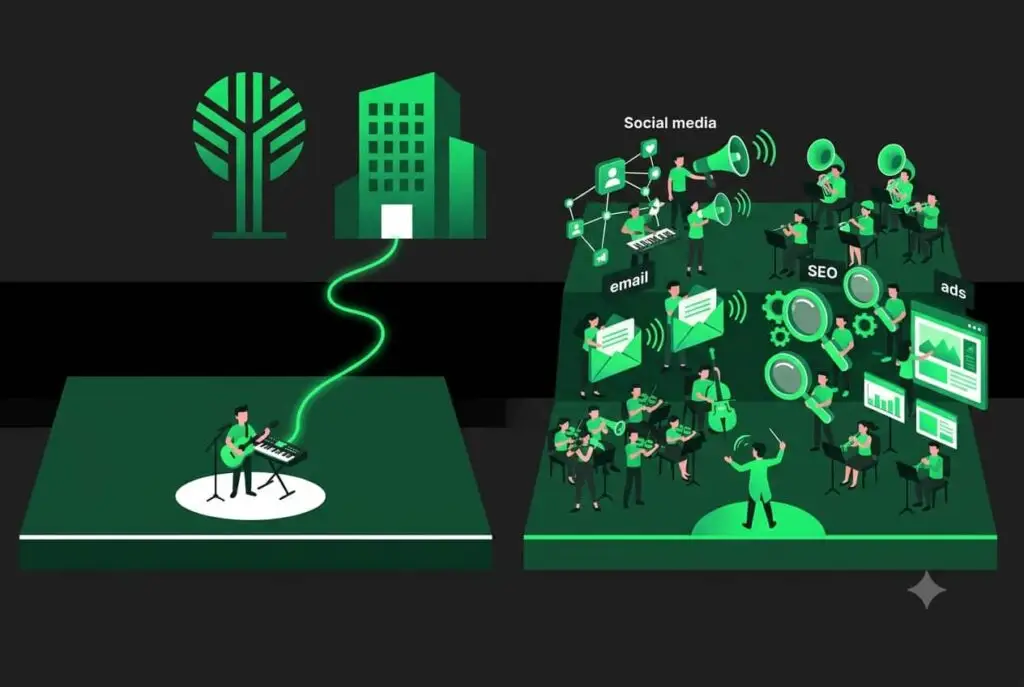
Before you invest time or money into either, it helps to know what you’re actually choosing between. Digital marketing is the full set of channels businesses use to grow online. Affiliate marketing is one of those channels, a performance-based model where you pay outside partners only when they deliver a sale or a lead.
They’re not competing strategies. One contains the other. This guide explains the difference and helps you figure out where to start.
What Is Digital Marketing?
Digital marketing covers any marketing effort that uses the internet or digital channels to reach potential customers. It’s a broad category by design because businesses have many ways to reach people online, and those channels often work best when used together.
The main channels include:
- SEO (Search Engine Optimization): Getting your website to rank in Google for the searches your customers are already doing
- Paid advertising (PPC): Running ads on Google, Meta, or other platforms where you pay per click or impression
- Social media marketing: Building an audience and driving engagement on platforms like Instagram, LinkedIn, or Facebook
- Email marketing: Nurturing leads and staying in front of existing customers with targeted campaigns
- Content marketing: Creating blog posts, videos, and resources that attract and educate your audience
What ties all of these together is control. You set the strategy, the messaging, the targeting, and the budget, and that ownership is what makes digital marketing the foundation most businesses build first.
What Is Affiliate Marketing?
Affiliate marketing is a performance-based model where a business pays a commission to a third party (the affiliate) for driving sales, leads, or clicks. What sets it apart from other digital marketing channels is that the business only pays when a result is delivered. No conversion, no cost.
Three parties are always involved:
-
- The merchant: The business that owns the product or service
- The affiliate: The publisher, blogger, influencer, or content creator doing the promoting
- The customer: The person who sees the affiliate’s content and makes a purchase
Here’s a concrete example. A food blogger reviews a meal kit subscription service and includes a unique tracking link. When a reader clicks that link and signs up, the blogger earns a commission (say, $30 per new subscriber). The meal kit company gets a new customer; the blogger gets paid.
According to Influencer Marketing Hub, affiliate marketing drives approximately 16% of all ecommerce orders in the US, making it a meaningful growth channel for businesses with a proven product that want to scale their reach through external partners.
Affiliate Marketing vs Digital Marketing: Key Differences
Simply put, digital marketing is the category, and affiliate marketing is one tactic within it. The differences in how they operate, who controls them, and what they cost are worth understanding before you decide where to invest.
Scope
Digital marketing is broad. It spans every channel a business uses to build an online presence and attract customers. Affiliate marketing is narrow. It’s a specific model in which external partners handle the promotion in exchange for a commission.
Who Uses It
Digital marketing is a tool businesses use to grow their brand. Affiliate marketing is used by both businesses as a sales channel and individuals as a revenue stream, without needing their own product.
Cost Structure
Digital marketing can be bought in several ways, including cost-per-click (CPC), cost-per-thousand-impressions (CPM), and flat monthly retainers. Affiliate marketing is purely performance-based. You only pay when the affiliate delivers a result, which reduces upfront financial risk but gives you less control over how your brand is represented.
Control
With your own digital marketing campaigns, you control the creative, targeting, landing page, and budget. With an affiliate program, you set the rules but can’t manage every piece of content an affiliate produces or every audience they reach. Some affiliates are exceptional partners. Others aren’t.
Speed of Results
Paid digital ads can drive traffic within hours of launching. SEO builds slowly but compounds over time; a well-optimized post can generate leads for years. Affiliate marketing takes longer. Building a productive network of partners isn’t a quick process.
Affiliate Marketing vs Digital Marketing at a Glance
| Factor | Digital Marketing | Affiliate Marketing |
| Scope | Broad (many channels) | Narrow (one channel) |
| Who runs it | The business | Third-party affiliates |
| Cost model | CPC, CPM, retainer | Commission on results |
| Control level | High | Low to medium |
| Speed of results | Fast (paid) to slow (SEO) | Slow to build |
| Best for | Brand building + lead generation | Scaling reach through partners |
Is Affiliate Marketing Part of Digital Marketing?
Yes, and it’s worth saying directly because this is the part that trips people up most. Affiliate marketing doesn’t sit outside of or in competition with digital marketing. It’s a subset of it.
Think of digital marketing as a full toolbox. Inside that toolbox, you’ve got SEO, paid advertising, email campaigns, social media, and content marketing. Affiliate marketing is another tool in that box, one that relies on external partners to promote on your behalf.
A business can run a strong digital marketing strategy with no affiliate program at all. But every affiliate program is, by definition, a form of digital marketing. They’re not either/or; they sit at different levels of the same structure.
READ: How SEO Services for Hotels Can Boost Direct Bookings and Online Visibility
Which Is Better for Your Business?
The answer depends on where your business is right now. Here’s a straightforward way to think about it.
Start with digital marketing if:
- You’re still building your online presence
- You don’t have consistent traffic yet
- Your offer hasn’t been fully validated
- You want channels you own and control that compound over time
Add affiliate marketing later if:
- You have a product with proven demand
- Your sales process already converts
- You want to grow your reach without increasing your ad spend
- You’re ready to manage outside partners and maintain brand consistency
Keep in mind:
- Affiliate marketing works as an amplifier, not a foundation
- Building a productive affiliate network takes time and ongoing management
- The businesses that see strong affiliate returns almost always have a working digital marketing strategy already in place
Start with the foundation. Add affiliates when you’re ready to scale.
Build a Strategy That Works for Your Business
Both affiliate marketing and digital marketing have a place in a modern growth strategy, but they’re not interchangeable. For most small businesses, the order matters. Build your digital marketing foundation first, get consistent traffic, and develop a sales process that converts. Then consider affiliate marketing to scale what’s already working.
The most successful businesses don’t bet everything on one channel. They build connected marketing systems where each piece supports the next.
That’s exactly what we do at Sierra Exclusive. If you’re ready to build a digital marketing strategy that drives real, measurable growth for your business, we’d love to help. Get in touch with our team today, and let’s figure out the right path forward together.
Frequently Asked Questions
What is digital and affiliate marketing?
Digital marketing is any marketing done through online channels. Affiliate marketing is a performance-based model where partners promote a business’s products and earn a commission per sale or lead. Both can work together as part of a broader growth strategy.
Is digital affiliate marketing legit?
Yes. It’s a well-established model used by major companies including Amazon, Shopify, and HubSpot. Businesses only pay for results, and affiliates earn real income when paired with the right product and audience.
Is digital marketing the same as affiliate marketing?
No. Digital marketing is the umbrella term for all online marketing activity. Affiliate marketing is one strategy that falls under it. A business can run a full digital marketing program with no affiliate channel at all.
Is affiliate marketing part of digital marketing?
Yes. It sits alongside SEO, PPC, email, and social media as one channel within digital marketing. What makes it distinct is that businesses only pay when an affiliate delivers a result, whether that’s a sale, a lead, or a click.