
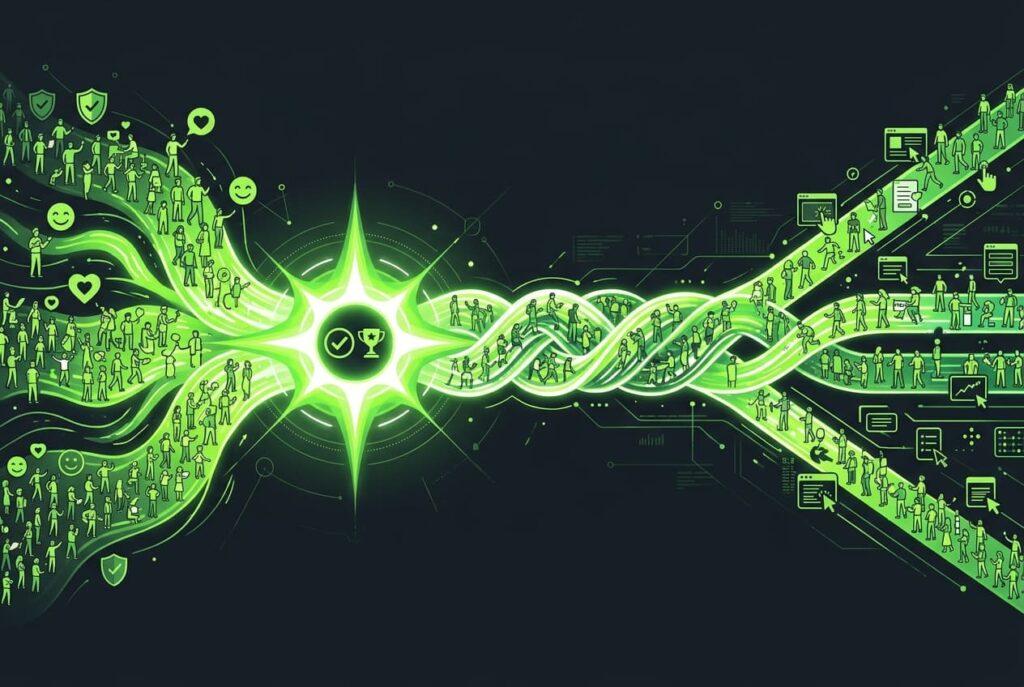
Most businesses think the customer journey and the user journey are the same thing. They’re not. One is about how people find and choose you. The other is about what happens when they actually show up. Mixing them up, or ignoring one entirely, is one of the most common reasons marketing budgets get wasted.
Here’s what each one means, how they differ, and how using both together turns more visitors into paying customers.
What Is the Customer Journey?
The customer journey is the full sequence of experiences a person has with your business, from the moment they first hear about you to becoming a loyal customer who refers others. It’s broad, spans weeks or months, and lives inside your marketing strategy.
Most customer journeys follow five stages:
- Awareness: A homeowner searches “best roofing contractors near me” and finds you for the first time.
- Consideration: They read your reviews and compare you against competitors.
- Decision: They request a quote from you specifically.
- Retention: They hire you again for another project.
- Advocacy: They refer a neighbor and leave a five-star review.
Each stage needs a different approach. Awareness requires visibility, and that’s where a solid SEO strategy and paid advertising do the work.
Consideration needs trust signals. Decision needs a clear offer and a frictionless path to say yes. According to HubSpot, companies that actively map their customer journey see up to 54% greater return on marketing investment.
What Is the User Journey?
The user journey is narrower. It describes the specific steps a person takes when interacting with your website or digital product to complete a single task. It’s not about whether they found you. It’s about what happens once they’re already there.
A potential client clicks your Google ad, lands on your services page, scrolls for pricing, can’t find it, and leaves in under a minute. That’s a broken user journey. They were interested. Your website lost them.
User journey mapping is the practice of walking through your site with fresh eyes. The goal is to spot where visitors get confused, drop off, or can’t complete a basic task like submitting a contact form or finding your phone number.
Customer Journey vs User Journey: Key Differences
The customer journey is your marketing strategy, and the user journey is your website experience. They serve the same end goal (more sales), but through completely different lenses.
| Customer Journey | User Journey | |
| Focus | Full lifecycle from stranger to loyal customer | Single interaction with a website or product |
| Timeframe | Weeks, months, or longer | Minutes to hours |
| Owned by | Marketing team | UX / web design team |
| Goal | Drive awareness, trust, and purchase | Remove friction and improve task completion |
| Tools | Journey maps, content strategy, CRM | Wireframes, user testing, site analytics |
| Sierra Exclusive connection | SEO, paid ads, social media | Website design and development |
Most business owners blame their marketing when leads don’t convert. But the bottleneck is often the user journey, not the customer journey. The ad worked. The website didn’t. This is where revenue quietly disappears.
Why Most Businesses Only Focus on One
Two failure patterns show up constantly with small businesses:
- Pattern A: Heavy marketing, weak website. Real traffic is coming in, but the site is slow and unclear. Leads trickle in despite the effort, not because of it.
- Pattern B: Great website, no traffic strategy. A well-designed site with no content plan, no paid advertising, and no way to get the right people there. The site sits quiet.
Neither works alone. Running ads to a broken website is like filling a leaky bucket. You keep pouring in traffic, but it disappears just as fast. According to Forrester Research, a well-designed user experience can raise conversion rates by up to 400%. That number matters only if people arrive at the experience in the first place.
How to Use Both to Drive More Sales
Map Your Customer Journey First
Understand the stages your customers move through before they buy. What are they searching for? Where do they find you? What pushes them to finally reach out? These answers shape your content strategy, keyword targets, and ad messaging.
Audit Your User Journey Next
Walk through your own website as a first-time visitor. Is it immediately clear what you do? Can someone find pricing without digging? Is the call to action obvious above the fold? Is the page fast on mobile? Most business owners are too close to their own site to see it clearly. That’s where an outside audit makes a real difference.
Find the Gaps and Fix Them
The overlap between both journeys is where most businesses lose money. Someone clicks your ad, lands on a slow page, and leaves in 20 seconds. The marketing worked. The website didn’t. When you fix user journey friction, you get more results from traffic you’re already paying for, often faster than running more ads.
Align Your Marketing and Website Teams
The people running your ads need to be talking to the people building your website. When a Facebook ad promises a free consultation, and the landing page never mentions it, trust breaks immediately. Both journeys need to tell the same story.
Conclusion
The customer journey and the user journey aren’t competing ideas. They’re two sides of the same coin. One brings the right people to you. The other makes sure they don’t leave empty-handed.
Sierra Exclusive helps Sacramento-area businesses build both. Whether you need a smarter SEO strategy to drive qualified traffic or a website design built to convert visitors into leads, it starts with understanding where each journey breaks down.
Book a free consultation and let’s take a look together.
Frequently Asked Questions
What is a customer journey?
The customer journey is the full path a person takes from first hearing about your business to becoming a paying customer. It covers five stages: awareness, consideration, decision, retention, and advocacy.
What is a user journey?
The user journey is what happens once someone lands on your website. It tracks the steps they take to complete a task, like finding your services, reading your pricing, or submitting a contact form.
What are the 5 stages of a customer journey?
Awareness, consideration, decision, retention, and advocacy. Awareness is when they first find you. Consideration is when they compare options. Decision is when they buy. Retention is when they come back. Advocacy is when they refer others.
How do you improve the customer journey?
Map every touchpoint from first search to post-purchase. Then identify where people drop off or lose trust. Common fixes include better content at awareness, clearer CTAs at decision, and follow-up emails or retargeting at retention.