
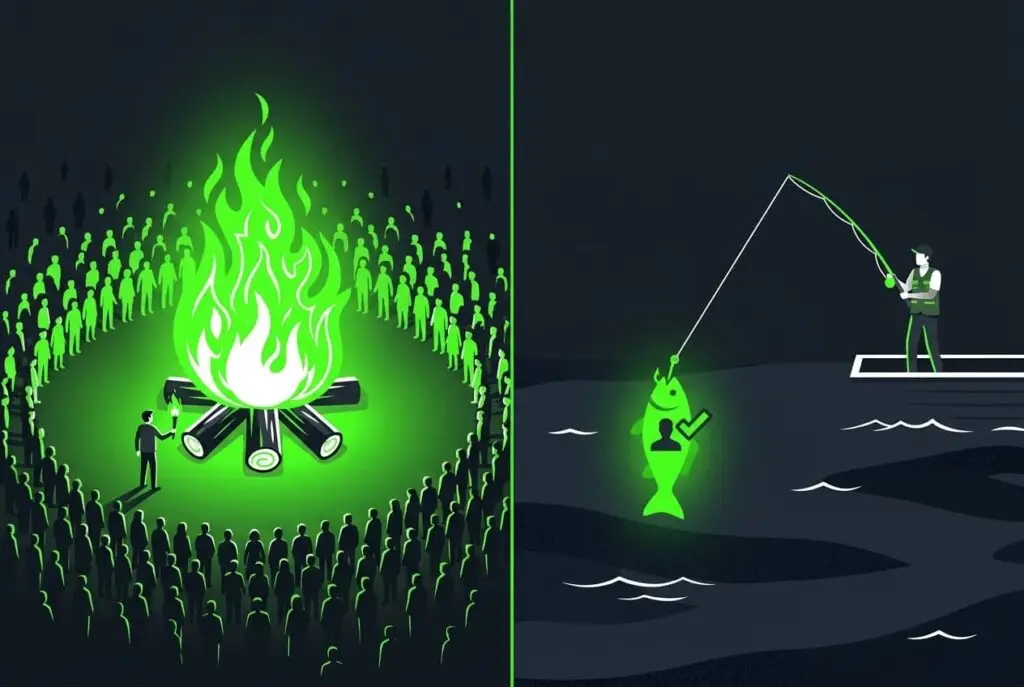
You’re running ads. Traffic is coming in. But revenue isn’t moving. Or maybe the opposite: you’ve got a steady stream of leads, but none of them know who you are, and they’re shopping three other vendors at the same time.
Sound familiar? In both cases, the root cause is often the same: confusing demand generation vs lead generation. People often use these two strategies interchangeably, but they serve completely different purposes. Using the wrong one for where your business is right now is one of the most common and costly digital marketing mistakes.
This post breaks down what each means, how they differ, and how to figure out which one your business should focus on right now.
What Is Demand Generation?
Demand generation is the process of creating awareness and interest in your product or service among people who don’t yet know they need it. It’s top-of-funnel work. The goal isn’t an immediate conversion; it’s to make sure that when they’re ready to buy, your name already comes to mind.
Common demand generation tactics include:
- Content marketing: blog posts, guides, and resources that answer questions your audience is asking before they’re ready to purchase
- SEO: ranking for topics and terms your ideal customers search months before they buy
- Social media: building an audience on the platforms where your customers spend time
- YouTube and podcasts: long-form content that builds authority and trust over time
- Paid awareness campaigns: display, YouTube, and social ads designed to introduce your brand to new audiences
- PR and earned media: getting mentioned in the places your audience already reads
To see how paid display advertising fits into a broader demand generation strategy, read our guide to running demand generation campaigns with Google Display Ads.
The metrics that matter in demand generation aren’t conversion rates; they’re reach, impressions, organic traffic, and brand search volume. You’re not harvesting yet. You’re planting.
What Is Lead Generation?
Lead generation is the process of capturing contact information or buying intent from people who already know they have a problem and are actively searching for a solution. It’s mid-to-bottom-of-funnel. Unlike demand gen, the goal is immediate action: a name, an email address, a phone number, or a booked call.
Common lead generation tactics include:
- Landing pages and contact forms: with clear, specific calls to action built to convert traffic into contacts
- Gated content: eBooks, whitepapers, and checklists that offer real value in exchange for an email
- Demo requests and free trials: for service and software businesses where prospects need to experience the offer
- PPC search ads: targeting people actively searching for what you provide right now
- Retargeting campaigns: re-engaging visitors who’ve already shown interest but haven’t converted
- Lead magnets: free tools, audits, and templates that earn contact info by solving a specific problem
See how our SEO-driven lead generation services help businesses attract and convert the right visitors.
With lead gen, the metrics shift completely. You’re tracking cost per lead (CPL), form fills, conversion rates, and marketing qualified leads (MQLs). The question isn’t “did people see us?” It’s “did they raise their hand?”
Demand Generation vs Lead Generation: The Key Differences
Here’s the comparison most people need before making a smart decision about where to focus. These aren’t subtle differences; they’re fundamental ones.
| Dimension | Demand Generation | Lead Generation |
| Goal | Build awareness and interest | Capture intent and contact info |
| Funnel Stage | Top-of-funnel (TOFU) | Mid-to-bottom-of-funnel (MOFU/BOFU) |
| Audience | Cold, doesn’t know you yet | Warm, already problem-aware |
| Key Metrics | Traffic, reach, impressions, brand search volume | CPL, form fills, conversion rate, MQLs |
| Primary Tactics | SEO, content marketing, social, brand ads | PPC search ads, landing pages, lead magnets |
| Time Horizon | Long-term brand building | Shorter-term pipeline filling |
The businesses that struggle most with paid advertising aren’t running the wrong ads; they’re running lead-gen tactics against cold demand-gen audiences. With no prior awareness, every lead has to be educated from scratch, which drives up CPL and drives down close rates. Neither column is better. They serve different jobs at different stages of the buyer journey.
Do Demand Generation and Lead Generation Work Together?
Yes, and most growing businesses have to. They aren’t competing strategies. They’re sequential ones. Think of it this way:
Demand gen fills the top of the marketing funnel → Lead gen captures the middle and bottom.
When you run demand generation without lead capture, you build awareness but miss the conversion. People visit your site and leave.
When you run lead generation without demand generation, you’re fishing in a cold pond. You’ll pay more per lead, attract lower-quality prospects, and face more “who are you again?” conversations in your sales calls.
The strongest marketing systems run both. According to HubSpot’s State of Marketing Report, companies that align both strategies generate 50% more sales-ready leads at a 33% lower cost per lead. Demand gen creates the audience. Lead gen converts it.
How to Know Which One Your Business Should Focus On Right Now
Here’s a practical decision framework to figure out where your business should be focused right now.
Focus on Demand Generation if…
- Your business is new or not widely known in your market
- Your organic traffic is low, and people aren’t searching for you by name
- You’re entering a new market or launching a new service line
- Your sales team consistently reports that leads have never heard of you before the first call
- Your brand search volume is close to zero
If any of these describe you, lead gen alone won’t fix it. Running ads to a cold audience burns budget without producing quality pipeline. Build recognition first.
Focus on Lead Generation if…
- You have solid organic traffic or brand awareness, but you’re not converting it
- You have a proven offer and just need more people to take action on it
- Your sales cycle is short, and you need immediate pipeline to hit revenue targets this quarter
- You’re already running paid advertising but have no real lead capture in place: no dedicated landing page, no strong offer, no follow-up sequence
- You’re generating traffic but watching visitors leave without a path to engage
If this sounds like you, the problem isn’t demand gen; it’s capture. Fix the bottom of your funnel before adding more fuel to the top.
Do Both if…
- You have budget to invest across multiple channels simultaneously
- You’re an established SMB ready to build a scalable growth system rather than patch individual channels
- You want to reduce dependency on any single traffic source or lead channel
- You’re planning for the next 12–24 months, not just trying to fill next month’s pipeline
Running both doesn’t require doubling your spend. It means allocating intentionally: some toward building your audience, some toward converting it.
How Sierra Exclusive Approaches Both Strategies
At Sierra Exclusive, we don’t treat demand gen and lead gen as separate line items. We build them as a connected system, because that’s what actually produces growth for small and mid-sized businesses.
On the demand generation side, our SEO-driven lead generation and content work build organic visibility that makes every paid campaign more efficient over time. On the lead generation side, we design high-converting websites and landing pages to turn that awareness into contacts, paired with paid search and retargeting to capture buyers who are actively in-market.
We tie it all together with CRM integrations and AI automation so no lead gets lost. Getting the lead is half the job. Nurturing it into a customer is the other half.
The Bottom Line
Demand generation and lead generation both matter. The mistake is not knowing which one your business needs right now, and treating them as separate campaigns instead of a connected system.
If you’re early-stage or breaking into a new market, start with demand. Build the recognition and trust that make every future lead cheaper and easier to close. If you’ve already got awareness but aren’t converting it, shift toward lead gen. Build the capture mechanisms that turn interest into revenue.
Whether your business needs more awareness, more leads, or both, Sierra Exclusive builds full-funnel marketing systems covering SEO, paid ads, CRM, and everything in between. Let’s talk about what it would take to scale.
Frequently Asked Questions
What is demand generation in marketing?
Demand generation builds awareness among people not yet looking for your product. The goal is to create a pipeline of future buyers who already know your brand when they’re ready to purchase.
What is lead generation in digital marketing?
Lead generation captures contact information from people already searching for a solution. The goal is an immediate action: a sign-up, a form fill, or a booked call.
What is the difference between demand generation and lead generation?
The core difference is timing and intent. Demand gen targets cold audiences to build awareness; lead gen targets warm audiences to convert that interest into a contact or a sale.
Is lead generation worth it for small businesses?
Yes, but only when your business already has brand awareness and a clear offer. Running lead gen against a cold audience produces expensive, low-quality leads with a poor return.
Can you do demand generation and lead generation at the same time?
Yes, and for most businesses, you should. They work best as a system: demand gen builds your audience at the top of the funnel while lead gen converts them at the bottom.